We met in at Burlington’s Old North End Community Center for Workshop #2!
Meet Macauley

Workshop photo by Macauley Lerman
Photographer/videographer Macauley Lerman joined us for the day to meet everyone. His role is to help us create materials for the final exhibit and document the activities of the first year of the Program. He will be available to accompany each of you to one site visit between April and November to take some video footage and photos related to your project (if you so choose). The photos/video will be yours to keep and share with your community and may also be used for the final exhibit, pending, of course, the approval of community members represented in the photos/videos.
Macauley also took some photos during the workshop! Click below to check them out. This gallery is a private link right now; if there are any photos you’d like removed just let us know (communityfellows@vtfolklife.org). We may use some of these images for publicity in the future, but we’ll check back in with you first before this happens.
Sharing about first interviews
Everyone shared about their experiences with their first interviews: what went well, what was challenging, and any questions that came up through the process. A few things we discussed:
Recording and technical questions:
Interviewing more than one person: A few people asked about recording interviews with multiple people. In this scenario it’s ideal to have one microphone per person. When interviewing two people at the same time it’s possible to pass the microphone back and forth between the two, especially when using a floor mic stand with a boom arm, however you risk people’s answers being partially recorded if people start talking before the mic has been repositioned.
Remote interviewing: Several people asked about remote recording. If recording remotely allows you the best access to the people you want to talk to it’s definitely worth doing. You can record remotely via a web-based platform like Zoom or Zencastr; there are also phone-based apps. Check out this guide to remote recording from Vermont Folklife for some more ideas.
Recording people while they’re walking around or doing something: This can be a great way to connect with people, though it presents a recording challenge. We do have some clip-on mics and other recording tools that could help you get a better recording.
If you’d like help planning for a specific interview scenario check in with
Mary Wesley or Andy and they can help you make a plan!
Interview dynamics:
The balancing act of wanting to zero in on specific themes or topics during an interview while also leaving space for the interviewee to take the lead in what they want to share. People shared experiences of sitting back and letting an interviewee expand in any direction they like, and at other times trying to pause or redirect the interview.
Several people had interviewed someone they knew quite well, either a family member or a friend/colleague from a shared professional sphere. In some cases folks felt they needed to encourage or directly ask their interviewees to talk about things already known to the interviewer based on their prior relationship for the sake of the recording. In some cases people learned something new by inviting these familiar topics in an interview setting. Others witnessed their interviewees struggle with what to share and not share “on tape.” Some people noticed it was helpful to take a break part way through an interview and then continue the exchange.
These are common experiences when interviewing! For some more perspectives on the dynamics of long form, ethnographic interviewing, as well as other forms of data collection we’ve shared a chapter from the book Shane the Lone Ethnographer in the VCFP 2025 - RESOURCES Google Folder (look in the subfolder for “Workshop 2”).
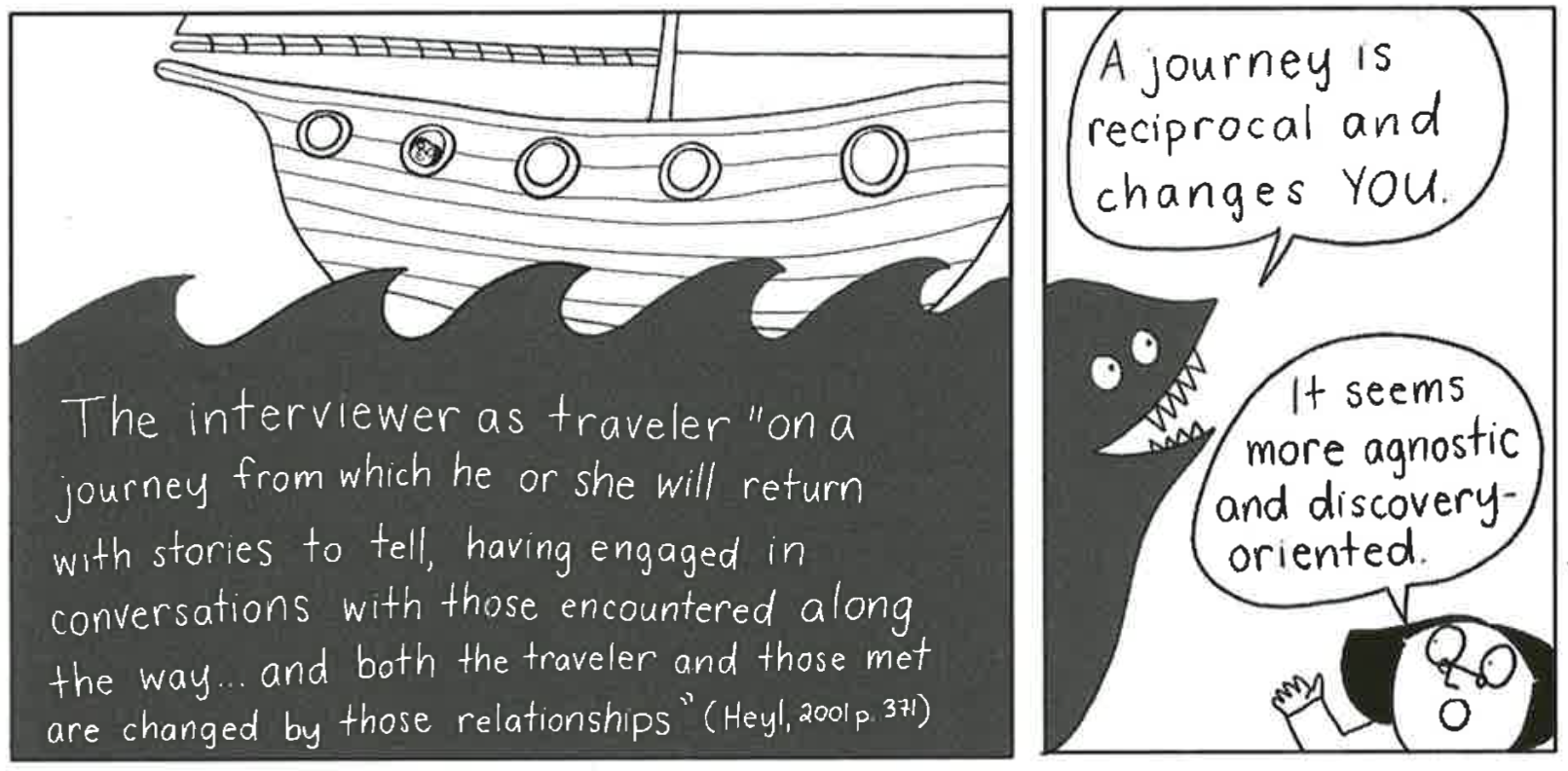
from Shane the Lone Ethnographer, Chapter 6: Ethnographic Data and Methods, p. 87
File management and transcripts
As you continue recording interview for your project we’d like you to begin creating transcripts of your interviews. Please refer to the Workshop 2 Fieldwork Activities document for more instructions on transcripts.
For those who want to use Trint, an online automated transcription tool, you are welcome to use the shared VCFP account. Login info will be shared in the post workshop #2 email.
Need help logging in and uploading files? In the RESOURCES folder you’ll find a subfolder with “Instructions for Trint”
Group exercise: Observation
Observation, or “observant participation,” is one of the many fieldwork methods we encourage you to use throughout the course of your project. You’ll find a description of the observation exercise we did during workshop #2 in the RESOURCES folder. Check out the slides for more information.
Field Notes

Remember to write field notes!
Your field notes journal is an essential tool in your research process. We discussed different forms of making field notes including:
Freewriting
Continuous narrative or descriptions
Double-entry notes
Scratch notes
Reflective audio recording
Annotated images
Drawing or sketching
Other research
Andy walked us through some resources to help you get started with background research on your topic:
Newspapers.com
Libraries
Local historical societiesakolovos@vtfolklife.org
Archives and special collectionsakolovos@vtfolklife.org
And of course…the Vermont Folklife Archive!
Review the workshop slides in the RESOURCES folder for more details and contact Andy (akolovos@vtfolklife.org) with any questions.