
The Farm Series Collection
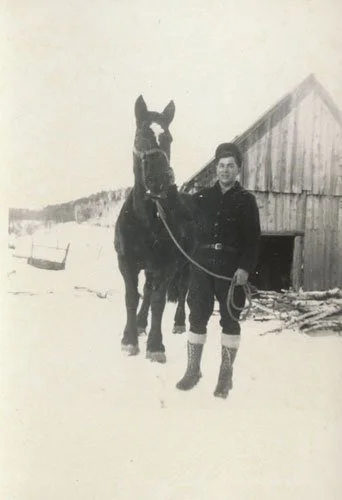
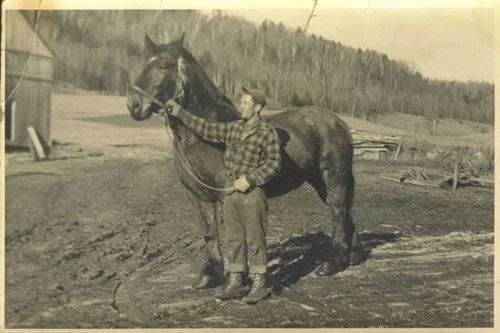
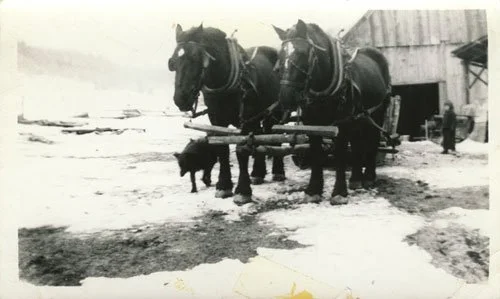
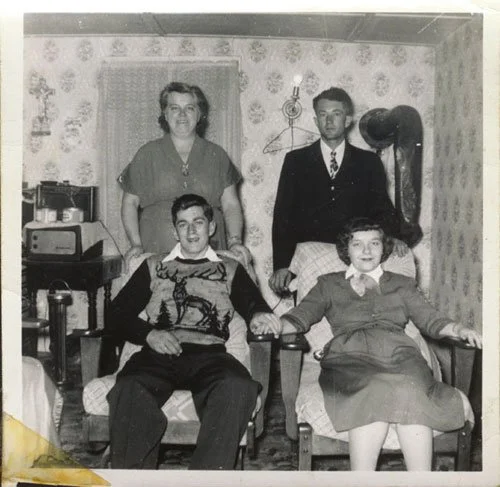
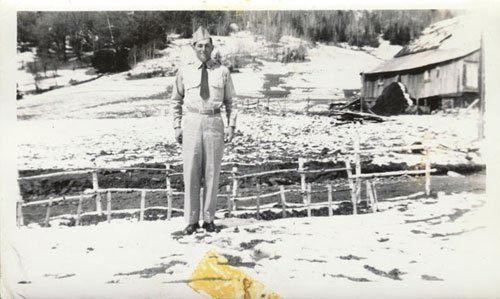
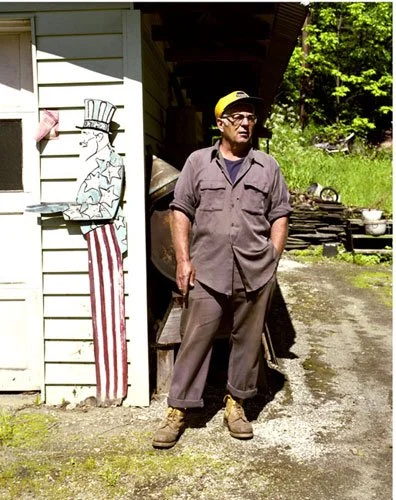
In the late ‘80s and early ‘90s Vermont Folklife folklorist Greg Sharrow conducted nearly 200 interviews with farmers in central Vermont and other parts of the state with the goal of gaining a deeper understanding of the culture of farming and farm life in Vermont during the early and mid 20th century. From these interviews, Greg and audio producer Ev Grimes created the award-winning audio documentary series, Never Done: Farm Life in Vermont in 1993. As with all Vermont Folklife’s research projects, the materials created by Greg and his research partners became a part of the Vermont Folklife Archive—and the “Farm Series Collection” (as we call it) is one of the richest, and largest, collections in our archives.
This summer our Vermont Folklife interns Lexi McCloud (Berea College) and Anita Miller (Princeton University) spent time reading through transcripts and listening to interviews to help us in the long process of describing the contents of the collection—one interview at a time. Down the road this helps us with our goal of making the Farm Series Collection accessible online. In the short term—well, these recordings are a treasure trove, and Lexi and Anita turned up a lot of wonderful things. And because our interns rule, Lexi stepped up and created a series of clips to showcase some of the amazing things found.
Wallace Illsley - Down on the Farm poem
Wallace Illsley (1914-2004) was a farmer in Braintree, Vermont who really loved horses. Even into the 1990s, Wallace and his wife Sybil drove to church in a horse-and-buggy! Each spring, Wallace sugared with horses. In this clip, Wallace recites the poem Down on the Farm, which has no clear author; it often appears in song format sung to the melody of the American folk tune, Turkey in the Straw. There is a documented recording of Down On The Farm in the Library of Congress collected by Charles Todd and Robert Sonkin, and Sung by Ian Hoag in Cassadega, N.Y, near Lake Erie
-
WI: You aren't on now, are ya?
GS: Yes.
WI: Well do you want me to start out, tell you just what farm life is like?
Down on the farm about half past four,
I slip on my pants and I sneak out the door.
Across the yard, I'll run like the dickens,
to milk the cows and feed the chickens.
Curry Nancy and Jiggs, slip all the pigs,
Work for 2 hours, eat like a Turk,
And by heck I'm ready for a full day's work.
I'll grease up the wagon, put on a hay rack,
Throw on a jug of cider in an old grain sack.
Hitch up the horses and hustle down the lane,
Must get the hay in for it looks like rain.
But I look over yonder, and sure as I was born,
The cattle on the rampage and the sheep's in the corn.
I start across the meadow, run a mile or two,
And heaving like I'm wind broke, and get wet clear and through.
Then get back to horses, for reck a pence,
Nancy's got straddled a barb wire fence.
My joints all aching and my muscles in a jerk,
I'm fit as a fiddle for a full day's work.
I'll work all summer till winter is nigh,
Figure up the books and heave a big sigh.
I've worked all summer, haven't made a thing!
I got less cash than I had last spring.
Now some folks say there ain't no hell.
But they never farmed, so how can they tell?
When spring runs around again, I'll take another chance,
Where the fringe grows long on my old gray pants.
I give my suspenders another hitch,
And my belt another jerk,
And by heck I'm ready for a full year's work.
Fred Davis - Farming with oxen
Fred was a farmer and lifetime resident of Bethel. He had a particular affinity for his oxen, and used them often for farm work and logging.
-
FD: Well, oxen go back in my family, I don't know how many generations, I don't know, my father had them, my grandfather had them, and I've had them, I grew up with them.
Probably the first pair I had, I was around twelve, or thirteen years old, that I trained from the beginning right straight through. And, well, oxen are not any more of a job to train than a horse, it just takes a little patience, and common sense. And if you begin to get up tight, just quit, it's the same with them, it's just with human beings, if you begin to get uptight just walk away and leave them.
Each animal like I said is different, and you have to do a little different along the line to train this animal. The main thing is being firm with them, but still getting them to explain, understand what you want. You can't, you can't lose your temper, you can't go overboard, cause like I said before if you begin to get uptight, leave them alone. You'll do them more harm than you'll do them good. A kind word and a pat on the back will go a lot further than a lot of other things.
All the field work, all the farm work, we used them in logging, it was, well they was used quite extensively in logging because they're not as nervous a disposition as a horse. And if you get into some little situation, where the horse might get nervous, an ox don't get very nervous. He's better in snow than a horse for this reason. Because he won't get thrashing around to tire himself out. He just plods along, he got that spade and that's all there is to it.
--Do you think it's a good thing that people are using tractors now?
FD: Yes, I do up to a point. I don't think a lot of these people are using tractors and making the money that I made with my teams. Because they're not getting that much more production and a lot more expense. But we had a certain amount of abuse, with different ones that had teams. Didn't understand the animals overworked them, didn't feed them too good and one thing or another, and we had a certain amount of abuse. So, that iron mule, you go out here, and you look around the different farms, and you'll see even they abuse them too. They don't grease them, they well run them into trees, and the like, they look like they've been through the Battle of the Bulge. It's the same thing with our automobiles. How many people you see have an automobile that isn't a year old, but it's, it's squeezed on both sides like an accordion. All the difference is that automobile don't feel it like an animal does.
John Messier - John & Tom
John was a logger from Brookfield who used horses extensively when sugaring or logging in the woods.
-
JM: If I was 10 years younger, today I'd have a horse even though I got a 4 wheel drive tractor, and I'd use the horse to pull the stuff around, and then use the tractor to bring it out of the woods.Working with horses is like working with another human being. They understand you, they're one of the smartest animals I ever worked with.
We had a pair of Morgans when we bought the farm, they were black. One was Tom and one was Molly. I had old Tom with me that day. When I got pinned under the tree he knew I was in trouble. I talked to him and he tried to pull the rope off, but the rope was too good and he couldn't. He knew I was in trouble, just like another human being would know. And he finally chewed the rope so he could break it, and he came over to me. I got a chain hooked on and the tree was leaning up in the air and my foot was down in the ground under it. He tried two three times, he couldn't move it. It was a big spruce tree.
I don't know how he moved it to this day. I just talked to him like a human being and he knew. The last time he turned around and looked at me, he gave it one heck of a lunge and he sunk himself right down into the ground and moved it just enough so it freed my toe for just an instant—freed my foot. And I was able to slide my foot out. I got out, crawled over and got on him and headed home. But those are things that tractors won't do for you.
Glenn Sanborn - Farming is out
Glenn lived in Chelsea and operated a harness shop for horses, which he inherited from his father. He was knowledgeable in both harness-making and repairing.
-
GS: Well how about farming? As time has gone along, how would you sum up what’s happened?
GS: Well, farming has gone out. Ha! Ha! Ha! Oh, yes. Geepers, you know, heck, this, that was of course the year that either, you was either a farmer or you worked on the farm. And a lot of the village people of course, worked for some of the farmers, and so on back in those days. In fact, I used to—when, in the summers when there wasn't business enough at the shop, didn't need to cause that was always a quiet time of year—so I'd work out in haying and so on. But, then of course, the farmers they went into heavy machinery and so on, and I think that's what killed a lot of the smaller farms. Put them out of business.
Paul Silloway - Eras
Paul was a farmer and, most notably, sugarmaker who lived in Randolph. Him and his family—including his wife Louise—ran a successful sugaring operation that continues to be in business today.
-
PS: You see we've gone through the horse-drawn era. We farmed with horses as long as it was practical. And we had teams that we could plow with and we might have had three horses, and use one on the dump rake to rake hay with or something. You might say that was the horse-drawn era.
Then tractors come in, and bulk tanks. When bulk tanks come in, we had one of those among the first. We bought one from Greenwoods, they sold them down there. They had a couple of guys that came and installed it. Bulk tanks chased a lot of farmers out, cause they wouldn't put in a bulk tank. We were among the first bulk tanks around.
At the time I was shipping canned milk I think I was shipping 22 cans a day. We went bulk, and then it all went bulk and it was all pumped into the truck, no- body had to load it. The truck used to come down here…and throw all that milk up onto the truck. I made a block down here at my place. So I went from the milk house up one step and I was on this block, so it wasn't so high to throw the milk into as it was the other way.
Phil Waldo - Streams
Phil was a farmer who lived in Brookfield, who was particularly knowledgeable about fence making. He and his wife, Thelma, were both extensively involved in “Camp Randolph,” a group of cottages built on communally owned land near the Canadian border.
-
PW: Yeah, This is not what we have considered to be a normal season, but this is the way it's going to be. We have warmed up 30 degrees in 50 years.
GS: On what basis do you make this statement?
PW: Farmers live by weather.
[ pause to swat a fly? ]
GS: So you have noticed that trend?
PW: Definitely. Living outdoors you think about such things more. Acid rain, I don't think I pretend to know. But there are thousands of streams that are absolutely, totally dead in this state. Nobody is concerned; ‘Let's just work five days a week and raise hell weekends' is the way we think in this country now, for the most part. Nobody's gonna seriously consider anything that interferes with their good time.
GS: And are these streams dead because of acid rain?
PW: I don't know why they are.
GS: And how do you measure their deadness?
PW: Turn over a stone, there's nothing under it. No fish, no suckers, no nothing, no toads, no frogs; nothing in that stream at all. Ever so many streams have absolutely no life. Something is happening. I don't attempt to know the answers, I just see what has happened. I suppose it bothers me unnecessarily that people are so immune, they just don't give a damn.
Floyd Jenne - Mother Nature
Floyd was a farmer and carpenter who lived in Reading and manned the family farm alongside the help of his brother, Elmer. They raised a legendarily large pair of oxen—named Pete and Punk. Additionally, the Jenne farm was subject to frequent features in media, such as Forrest Gump, Funny Farm, Budweiser commercials, postcards, and Vermont magazine.
-
WI: The sugar house was built in 1896. So this year will be 100 years sap been boiling in it. Every year. The sap, it comes in cycles now. Back I've heard dad tell, 1870, that's when my grandfather, of course my father was just born then, had an old iron kettle, we got it down there. I used to have it shut out in in the shed. And he had 50 wooden buckets, them old wooden ones. He made 27 gallons of syrup out of it. He burned up 5 cord of wood I've heard him tell say.
Then they had a good year in 1900, that was another good year there. And 1930 was a good year, I remember that. I was 16. We had 495 buckets and made 395 gallons of syrup. 1960 was a good year. We made 1,050 gallons. So maybe 1990 will be a good year. We've had 3 poor years now. This last year wasn't too bad. Christ, I had 3,500 taps. I should make 2,000 gallons. Sap don't run the way it used to. Mother Nature.
Barbara Carpenter - The only constant
Barbara was a dairy farmer and sugarmaker who lived in Cabot. While not originally from Vermont, she purchased a home and several acres for dirt cheap when she was eighteen years old and moved there after graduating college. She and her older husband, Charles, engaged in what she believed to be the three core aspects of Vermont farming: dairy, sugaring, and logging. She was also a notable history buff and had a deep appreciation for farming traditions.
-
BC: We mustn't ever think that this farming economy's been stable, certainly not in this part of the world. I mean it's such a short time historically that this land has been farmed and it's gone through cataclysmic changes, you know from the sheep and just it's just that the only thing that's been constant is the terrific changes.
Ruth Shumway - Women in the barn
Ruth was a dairy farmer who lived in North Harland. After the death of her husband, she operated the farm by herself, which had been in her family since the early 1900s. She was hard-working, and had a deep knowledge of cattle, especially short horn cows.
-
GS: In this day and age it doesn't seem to be that unusual for a woman to be running a farm. But I would assume, I don't know, this is what I want to ask you: was it unusual for you to be so involved when you started out? Or did you ever think about that?
RS: I didn't think too much about it. A lot of people would come in, they'd want to talk to the boss. I said, “Well, I guess probably you are.” “Well, is your husband here?” I says, “I’m sorry, my husband is dead.”
Oh, then they tell me what they want, generally. If it's something to do with equipment, I send them out to see whoever was working here that took care of it. But as far as the cows go, I could tell them what they wanted to know. It hasn't bothered me any. I'm sure there are other ones that…they don't really feel the woman's place is in the barn.
GS: It seems like that era is a little bit over though, because nowadays so many women are in the barn.
RS: Um hum. Our technician has, I think he has 3 sisters that run a farm. Between the 3 of them they can do all there is to be done.
GS: Who are they?
RS: His name is Roger Lepine.
Sally Goodrich - A prize winning herd
Sally operated a dairy farm in Cabot with her husband, Walt Goodrich, on the land where he grew up. While she was not raised in a farming family, she became a successful dairy farmer alongside Walt. In fact, their jersey herd was recognized nationally based on its excellent production statistics.
-
— Do you think it’s more flexible now? That women have more choice?
SG: Yes, I think it's a very much more flexible, they have a great many choices, and a lot of this has been brought on by woman's movements and woman's lib. You know, women are much freer to make those choices. They used to, you know, you were kind of locked into a role in the past. And, now, I don't think that you are. You have more freedom, to select what you'd like to do. And I certainly did it, because it was my choice, it was never forced on to me
GS: Did you set out to consciously build a prize-winning herd?
SG: Yes! I did!
WG: Yes and no…the better the herd the more money you can make, and the more apt you are to pay your bills. So you just naturally work that way if you want to succeed.
SG: But I really did, I wanted to have the top herd in the country. Haven't quite made it yet, but that's what I want to do. And I'm never satisfied, no matter how good they do I'm always pushing for more.
GS: I know that there are many things involved in having a high-producing herd. So by asking you, ‘what does it take,’ I realize that's a big question. But if you could just maybe hit a little bit of it.
WG: Dedication is very high I guess.
SG: Yeah, you have to be totally committed to this way of life. Otherwise there's no way that you're going to work the number of hours in a day that we have to work, and do it just about 365 days a year. Now I realize that right now I've taken on a few outside jobs, a couple, that eat into a couple days a month on the average, maybe three. That doesn't sound like much. But when you're trying to farm that's an awful lot to take out. And we couldn't do it if we didn't have our son and his wife here now. There was quite a few years that we did it alone. That's a big commitment. It's not on and off kind of a deal. You can't do an excellent job one day, and then say I'm tired and I don't feel like doing it the next day. You got to be just plugging along every day.
Jane Pinello - Everybody works in the barn
Jane co-owned a dairy farm in Randolph with her husband Frank Pinello and her brother-in-law David Pinello. They began work on the farm in the early 1980s and purchased it several years later.
-
JP: The majority of women I know that are my age or around my age all work in the barn. And of them are expected to milk. They're expected to run the machinery, they're expected to
take care of kids. And often times the kids are right underfoot. There are very few that I know that don't work in the barn or in the field. Now that varies, as I said I went to New York State a couple years ago, and I was surprised to see that no other woman in the group worked at the barn. They all had household or outside jobs. In this area everybody works in the barn. And as Ruth Shumway who you know has her farm, that's her.
I don't think that in the last…I think it's changed. As my mother who was a farmwife didn't work in the barn. She did the milk room and took care of the calves, and I think that was a normal thing for a woman to do. Somehow it's been changed over. And I think the woman's role has become just as important as the men's role on the farm. And often times when you're dickering on a piece of machinery, in our family, it's a decision of three. I should make that point very clear; no decision in our farm is made by one person, it's made by the 3 partners,whether they're men or women, we always discuss things. And I think women know as much and are as involved as the men are. And I think they have a greater say in what goes on on the farm than they ever used to have. Anyways in my family they do.
Jane Reynolds - Farm Wife
Jane operated a farm in Randolph with her husband, Russell (whose family had originally owned the farm). She had a particular appreciation for interacting with and caring for farm animals.
-
JR: Farm Wife is a group, and it was started through the University of Vermont Extension Service. I assume it can be started by anyone. But that's who we used as a support person or resource person was a county agent.
The group that I'm in, some groups aren't as personal as the group that I'm in, but the group that I'm in, the ladies have a lot of faith in one another. It's a real different kind of thing because they aren't like your friends, it's not anybody that you are socialized with or anything, and you probably don't see them only when you go to this meeting. But if you had a problem, you might call one of those ladies. It's that kind of a relationship. It's a very, very strong bond, yet it's not a social thing, it's just that they all share in some of the same kind of problems and experiences. And by sharing them they don't all feel alone. When you know somebody else has got a problem worse than yours or at least got one like it, then it makes it easier.
Now one of the ladies I talked with said I've belonged to Grange, I belonged to all these social groups, and she said I never really had one person that I felt that I could discuss anything with, that I felt free to discuss anything with. Farm women run errands, you see them over street, they get their groceries, they go to the hardware store, they go to the farm machinery place. You see them out maybe as much or more than you do other women. But they never have the time to visit with anybody. Girls who work in the office when they have coffee, they sputter about the boss. Farm women never have a chance to sputter about their boss, they just live with him 24 hours a day.
Gert Lepine - Return to farming
Gertrude (“Gert”) was born into a farming family in Quebec during the late 1920s. Her family moved to Vermont in 1930, ultimately settling on a 140-acre farm in Morristown. While Gert briefly pursued a career in teaching, she returned permanently to the farm in 1952. Over the next four decades, Gert and her sisters—Jeanette and Therese—ran the farm together and built up a successful herd of Jersey cows.
-
GL: As a high school kid, I had a lot of admiration for a lot of my teachers, and I guess probably every kid does. And I said, gee, maybe that's not such a bad thing. At least you get respect. So I wasn't a bad student, so I signed up at Johnson State, which was a normal school then, strictly for elementary education. And it was very, very, very cheap, very affordable. And I'd come home every weekend and farm and my vacations were here. It was just the perfect life for me. And I got my degree and I signed up for a little school up in Bakersfield, rural. I wanted a one-room schoolhouse.
I was up there one year—I decided to go back a second year. They always advised us to at least spend two years in one school. So I went back for my second year and then my third year, well, I decided two years was enough up there. So there was an opening at Stowe. So I said, I'll go there, stay home, help dad and Lawrence with chores, night and morning, and then still do my schooling. And then, so that's the way it was going. And I was traveling from here to Stowe Hollow. You know, I was still keeping in touch with the farming. And that weekend, I'd worked in the sugar bush. We had tapped up and things were beautiful. It was just a beautiful spring. It was in April. And I was sitting there in the school room and I was having a class and all of a sudden I looked up and out the window and it was just so beautiful. And I just felt like breaking out in song, you know how some of that?
And you know when your school teachers sort of have, at least in those days, you know. They were watching you pretty close. I couldn't swear, when I felt like swearing, I wasn't supposed to swear, and when I felt like singing, I really couldn't sing when I having class. So, God, I said to myself, I was in, came in and I said, what am I doing here? I said I could be out there working in a sugar bush today. And I don't know, just those four walls, it'd been creeping up on me all winter.
So anyway, that night, I made up my mind right there. I said, this is it. So I came home and I asked Dad if he had a place for me to farm and he said, sure. So I called up the superintendent and he says, what do you mean you're quitting? He said, you've only got another month to go. I said I know, but no, I said absolutely not. I said this is it. I said something happened today in the school room and I said that I've made up my mind, I've gotta get out. And he said, that's gonna be the end of your teaching career. He said, you'll never have a chance for another contract. He said I'll see to that. And I said, That's okay, I said,
I want a farm. He said what do you mean you wanna go home to the farm? He said What are you gonna do, do the bookkeeping? And I say no, I don't like bookkeeping. I said, you look me up in 20 years and you'll see what I've done. So he said, okay, but you've got to stay there until I find somebody to replace you. I said okay, I'll give it another couple days. So that's the way it went. I came home and I've been here ever since.
Floyd Fuller - Evening dances / Corn husking
Floyd was born and raised in Randolph Center on the farm he would later come to operate. He had a particular affinity for horses and was a horse dentist. He was well-known for being able to “float” horses’ teeth.
-
FF: In the winter, most every Friday night, unless it was a big snow storm, travelling weren't fit, some of the neighbors through Warren out into Waitsfield, Waitsfield Common would have a dance Friday night. And they hired me and there was a lady, Mrs. Basha, she used to go with me. She played the organ or piano whatever the farmer had in the house, and I played the violin. And they'd move all the furniture out of the dining room and living room and everything and put it in the hall or in a bedroom or something and clear out the place. We'd start dancing at 9 o'clock. And then around 11 o'clock they'd stop and have a lunch. All the farmers in the fall would bring in pumpkin pie and cider and donuts and always have a good feed, have about a half an hour for break for lunch. And then we'd go play and we'd play till 1 o'clock.
And many times before 1 o'clock if people were having such a good time they'd pass the hat around and pick up a little money and dump it on top of the organ or piano and say will you play another hour? And we'd play till 2. And then occasionally there was always a few and they'd pass it again and we'd play till 3 o'clock in the morning. Then maybe out in Waitsfield Common, 10-11 miles from home with a horse and sleigh, zero or more to drive home, get home in the morning and at 4:30 and dad my brother would be go in the barn milking, change my clothes and go to the barn and go to milking, don't go to bed at all.
And we got a dollar and half for playing from 9 till 1, each one of us. And with the tips sometimes we used to get 2 dollars and a half, $2.65 and sometimes $2.75 apiece. And we thought we was makin’ money. But I don't think you could get anybody hardly to tune up the violin and play for ya for an hour for $2.75 a day. But that's the way I earned my spending money.
-
FF: And then when it got cured and that like, why you bring it in and used to have corn huskings. Husk corn till 11-12 o'clock at night. Neighbors would come in and husk corn and have a lunch. And if you found a red ear if there was any girls there, you could kiss some girl, whatever girl you want to helping us! So we used to husk all the corn by hand. And then the next morning we'd take that corn, pick the ears all up and carry them and put them into the corn crib, which was a slatted affair so the wind could go through. And that cured it and dried it. And after it was cured well then you could shell it and then grind it up for cornmeal.
GS: Where did the huskings take place and who came?
FF: Neighbors. (GS-Old, young?) Oh yes, all ages, they'd come in They used to announce that they got a lot of corn to husk, anybody wanted to come and help husk it, why you'd be welcome. They'd come and then they'd have some corn to husk, and someone have the corn ready before some of the others, and the neighbors would come in. They wouldn't have a big crowd, but you'd have 8 or 10 people maybe there, sitting around the barn floor husking corn and chatting and having a good time. And then you return the favor to help your neighbor to husk his corn. So they help one another and enjoyed themselves.
Floyd and Veneita Richardson - A red ear
Floyd and Veneita were a married couple who operated a farm in Hartland—which originally belonged to Floyd’s parents. They also ran a successful sugaring operation.
-
GS: As I remember you met under an interesting circumstance.
FR: [laughter] You hear that too?
VR: It was nothing very much, except he invited me to a husking bee. A small one.
FR: Yes, but I knew you before that.
VR: I guess we found a red ear or something. So that's how it all began.
John Messier - Box socials
-
JM: Then they had box socials. The women folks would all make up a box and put food in it and not let their husbands or anybody know what was in the box. Then they'd auction the boxes off and whoever box the men bought they'd eat with. And they'd dance with. And that's a box social.
GS: Within your memory?
JM: I've been to them. I was 16, they used to still have them down to East Braintree. The last one they had, my father bought a box for me and thought he was getting my aunt's box. Because he wanted this young girl's box and he wanted to eat with her. And I got the young girl's box, and he got my aunt's! So it didn't work out that way!
GS: I thought that was years ago. I've heard Blanche Jarvis talk about that.
JM: They was still having quite an active grange when we moved into East Braintree in 1955. We moved up in 1948 and we used to come up to East Braintree and play the dances, we came to box socials from '48 into the '50s until I went into the service in '53. After I come out of the
service then dances had kind of gone away from East Braintree. Things started to change, the grange started to slow down, then it finally dwindled to where it was just a memory.
GS: What happened to it?
JM: Television came in and young people changed. Back when I was a little kid if you belonged to the grange it was quite a thing because they had a lot of activities and it was what you believed in, your parents did and you did. Television killed the grange. Cars came in more, because when they had the biggest granges they didn't have a lot of cars. They had horses and buggies and few cars, but you didn't have nothing else to do on Saturday night but go to the grange or go to a dance. People had more things to do and different things to do.