
The Farm Series Collection
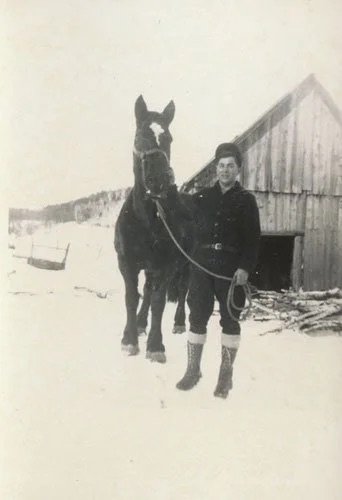
John Messier and his horse, Tom, in Brookfield, VT
In the late ‘80s and early ‘90s Vermont Folklife folklorist Greg Sharrow conducted nearly 200 interviews with farmers in central Vermont and other parts of the state with the goal of gaining a deeper understanding of the culture of farming and farm life in Vermont during the early and mid 20th century.
From these interviews, Greg and audio producer Ev Grimes created the award-winning audio documentary series, Never Done: Farm Life in Vermont in 1993. As with all Vermont Folklife’s research projects, the materials created by Greg and his research partners became a part of the Vermont Folklife Archive—and the “Farm Series Collection” (as we call it) is one of the richest, and largest, collections in our archives.
In the summer of 2026 Vermont Folklife interns Lexi McCloud (Berea College) and Anita Miller (Princeton University) spent time reading through transcripts and listening to interviews to help us in the long process of describing the contents of the collection—one interview at a time. Down the road this helps us with our goal of making the Farm Series Collection accessible online. In the short term—well, these recordings are a treasure trove, and Lexi and Anita turned up a lot of wonderful things. And because our interns rule, Lexi stepped up and created a series of clips to showcase some of the amazing things found.
Wallace Illsley (Interviewed in Braintree, VT, 11-30-1989)
Illsley recites a poem reflecting farm life
-
Wallace was a farmer and horseman who operated a small farm in East Braintree with his wife, Sybil Illsley. They shared a deep appreciation for traditional farming ways of life and could be seen using a horse and buggy as a means of local transportation into the 1990s.
The poem Wallace recites, known as Down on the Farm, has no clear author. It sometimes appears in song format, with variations on the lyrics, sung to the melody of the American folk tune, Turkey in the Straw, as documented in a recording held at the Library of Congress collected by Charles Todd and Robert Sonkin, and Sung by Ian Hoag in Cassadega, N.Y, near Lake Erie
-
WI: You aren't on now, are ya?
GS: Yes.
WI: Well do you want me to start out, tell you just what farm life is like?
Down on the farm about half past four,
I slip on my pants and I sneak out the door.
Across the yard, I'll run like the dickens,
to milk the cows and feed the chickens.
Curry Nancy and Jiggs, slip all the pigs,
Work for 2 hours, eat like a Turk,
And by heck I'm ready for a full day's work.
I'll grease up the wagon, put on a hay rack,
Throw on a jug of cider in an old grain sack.
Hitch up the horses and hustle down the lane,
Must get the hay in for it looks like rain.
But I look over yonder, and sure as I was born,
The cattle on the rampage and the sheep's in the corn.
I start across the meadow, run a mile or two,
And heaving like I'm wind broke, and get wet clear and through.
Then get back to horses, for reck a pence,
Nancy's got straddled a barb wire fence.
My joints all aching and my muscles in a jerk,
I'm fit as a fiddle for a full day's work.
I'll work all summer till winter is nigh,
Figure up the books and heave a big sigh.
I've worked all summer, haven't made a thing!
I got less cash than I had last spring.
Now some folks say there ain't no hell.
But they never farmed, so how can they tell?
When spring runs around again, I'll take another chance,
Where the fringe grows long on my old gray pants.
I give my suspenders another hitch,
And my belt another jerk,
And by heck I'm ready for a full year's work.
Wallace Illsley (Interviewed in Braintree, VT, 11-30-1989)
Illsley recites a poem reflecting farm life
-
Wallace was a farmer and horseman who operated a small farm in East Braintree with his wife, Sybil Illsley. They shared a deep appreciation for traditional farming ways of life and could be seen using a horse and buggy as a means of local transportation into the 1990s.
The poem Wallace recites, known as Down on the Farm, has no clear author. It sometimes appears in song format, with variations on the lyrics, sung to the melody of the American folk tune, Turkey in the Straw, as documented in a recording held at the Library of Congress collected by Charles Todd and Robert Sonkin, and Sung by Ian Hoag in Cassadega, N.Y, near Lake Erie
-
WI: You aren't on now, are ya?
GS: Yes.
WI: Well do you want me to start out, tell you just what farm life is like?
Down on the farm about half past four,
I slip on my pants and I sneak out the door.
Across the yard, I'll run like the dickens,
to milk the cows and feed the chickens.
Curry Nancy and Jiggs, slip all the pigs,
Work for 2 hours, eat like a Turk,
And by heck I'm ready for a full day's work.
I'll grease up the wagon, put on a hay rack,
Throw on a jug of cider in an old grain sack.
Hitch up the horses and hustle down the lane,
Must get the hay in for it looks like rain.
But I look over yonder, and sure as I was born,
The cattle on the rampage and the sheep's in the corn.
I start across the meadow, run a mile or two,
And heaving like I'm wind broke, and get wet clear and through.
Then get back to horses, for reck a pence,
Nancy's got straddled a barb wire fence.
My joints all aching and my muscles in a jerk,
I'm fit as a fiddle for a full day's work.
I'll work all summer till winter is nigh,
Figure up the books and heave a big sigh.
I've worked all summer, haven't made a thing!
I got less cash than I had last spring.
Now some folks say there ain't no hell.
But they never farmed, so how can they tell?
When spring runs around again, I'll take another chance,
Where the fringe grows long on my old gray pants.
I give my suspenders another hitch,
And my belt another jerk,
And by heck I'm ready for a full year's work.
Fred Davis (Interviewed in Bethel, VT, 08-27-1991)
Davis speaks about farming with oxen
-
Fred was a farmer and lifetime resident of Bethel. He had a particular affinity for his oxen, and used them often for farm work and logging.
-
FD: Well, oxen go back in my family, I don't know how many generations, I don't know, my father had them, my grandfather had them, and I've had them, I grew up with them.
Probably the first pair I had, I was around twelve, or thirteen years old, that I trained from the beginning right straight through. And, well, oxen are not any more of a job to train than a horse, it just takes a little patience, and common sense. And if you begin to get up tight, just quit, it's the same with them, it's just with human beings, if you begin to get uptight just walk away and leave them.
Each animal like I said is different, and you have to do a little different along the line to train this animal. The main thing is being firm with them, but still getting them to explain, understand what you want. You can't, you can't lose your temper, you can't go overboard, cause like I said before if you begin to get uptight, leave them alone. You'll do them more harm than you'll do them good. A kind word and a pat on the back will go a lot further than a lot of other things.
All the field work, all the farm work, we used them in logging, it was, well they was used quite extensively in logging because they're not as nervous a disposition as a horse. And if you get into some little situation, where the horse might get nervous, an ox don't get very nervous. He's better in snow than a horse for this reason. Because he won't get thrashing around to tire himself out. He just plods along, he got that spade and that's all there is to it.
--Do you think it's a good thing that people are using tractors now?
FD: Yes, I do up to a point. I don't think a lot of these people are using tractors and making the money that I made with my teams. Because they're not getting that much more production and a lot more expense. But we had a certain amount of abuse, with different ones that had teams. Didn't understand the animals overworked them, didn't feed them too good and one thing or another, and we had a certain amount of abuse. So, that iron mule, you go out here, and you look around the different farms, and you'll see even they abuse them too. They don't grease them, they well run them into trees, and the like, they look like they've been through the Battle of the Bulge. It's the same thing with our automobiles. How many people you see have an automobile that isn't a year old, but it's, it's squeezed on both sides like an accordion. All the difference is that automobile don't feel it like an animal does.
Wallace Illsley (Interviewed in Braintree, VT, 11-30-1989)
Illsley recites a poem reflecting farm life
-
Wallace was a farmer and horseman who operated a small farm in East Braintree with his wife, Sybil Illsley. They shared a deep appreciation for traditional farming ways of life and could be seen using a horse and buggy as a means of local transportation into the 1990s.
The poem Wallace recites, known as Down on the Farm, has no clear author. It sometimes appears in song format, with variations on the lyrics, sung to the melody of the American folk tune, Turkey in the Straw, as documented in a recording held at the Library of Congress collected by Charles Todd and Robert Sonkin, and Sung by Ian Hoag in Cassadega, N.Y, near Lake Erie
-
WI: You aren't on now, are ya?
GS: Yes.
WI: Well do you want me to start out, tell you just what farm life is like?
Down on the farm about half past four,
I slip on my pants and I sneak out the door.
Across the yard, I'll run like the dickens,
to milk the cows and feed the chickens.
Curry Nancy and Jiggs, slip all the pigs,
Work for 2 hours, eat like a Turk,
And by heck I'm ready for a full day's work.
I'll grease up the wagon, put on a hay rack,
Throw on a jug of cider in an old grain sack.
Hitch up the horses and hustle down the lane,
Must get the hay in for it looks like rain.
But I look over yonder, and sure as I was born,
The cattle on the rampage and the sheep's in the corn.
I start across the meadow, run a mile or two,
And heaving like I'm wind broke, and get wet clear and through.
Then get back to horses, for reck a pence,
Nancy's got straddled a barb wire fence.
My joints all aching and my muscles in a jerk,
I'm fit as a fiddle for a full day's work.
I'll work all summer till winter is nigh,
Figure up the books and heave a big sigh.
I've worked all summer, haven't made a thing!
I got less cash than I had last spring.
Now some folks say there ain't no hell.
But they never farmed, so how can they tell?
When spring runs around again, I'll take another chance,
Where the fringe grows long on my old gray pants.
I give my suspenders another hitch,
And my belt another jerk,
And by heck I'm ready for a full year's work.

2025
New York
The Atlast Project →
“Communication was top-notch and the final outcome was even better than we imagined. A great experience all around.”
Former Customer