The Vermont Community Fellows Program provides funding, practical skills, and ongoing mentorship to Vermonters ages 16+ to address shared needs through collaborative field research projects with the places, people and groups that matter to them. A collaboration between Vermont Folklife and Conversations from the Open Road, this three-year initiative aims to build statewide capacity for community-based, action-oriented field research. The Program is made possible by Senator Bernie Sanders through support provided by the National Historical Publications and Records Commission.
For its pilot year, the program accepted 13 applicants into its first cohort in January, 2025. Between February-June Fellows received in-depth training to inform and guide their ongoing work within their communities. For the remainder of the year these 13 Vermonters will each carry out a community action project based on what they’ve learned through interviews and fieldwork.
The work of this first cohort will be featured in a traveling exhibit launching in the spring of 2026. Until then, we’ll be featuring short interviews with each Fellow sharing their experiences in the Program so far.
Paul Kramer - Montpelier, VT
How does the Mad River Valley view itself today?
The following was adapted from a short interview with Paul. The text has been edited for clarity and readability.
Briefly describe what your experience has been like in this program so far:
The program has been inspiring! It has allowed me to pursue an interest - ethnography and audio work - that I previously have felt kind of ill-prepared to pursue on my own. One thing that I've really enjoyed about it is the ease with which I'm able to work with the program mentors. And then the other thing I really appreciate about the Fellowship program is the diversity of our cohort in age, gender, ethnicity, and life experience. I’ve learned a lot from my cohort.
(At this point) what is the overarching question about your community that’s guiding your research?
The overarching questions that I am seeking to get perspectives on include the following: How does the Mad River Valley view itself today? How does the Mad River Valley's past inform or influence its current sense of resilience to outside forces, whether these forces be climate, municipal support and funding, visitors, etc? More broadly, one thing that I'm taking away from this, that I hope maybe other people take away too—How do communities use the past to inform their future?
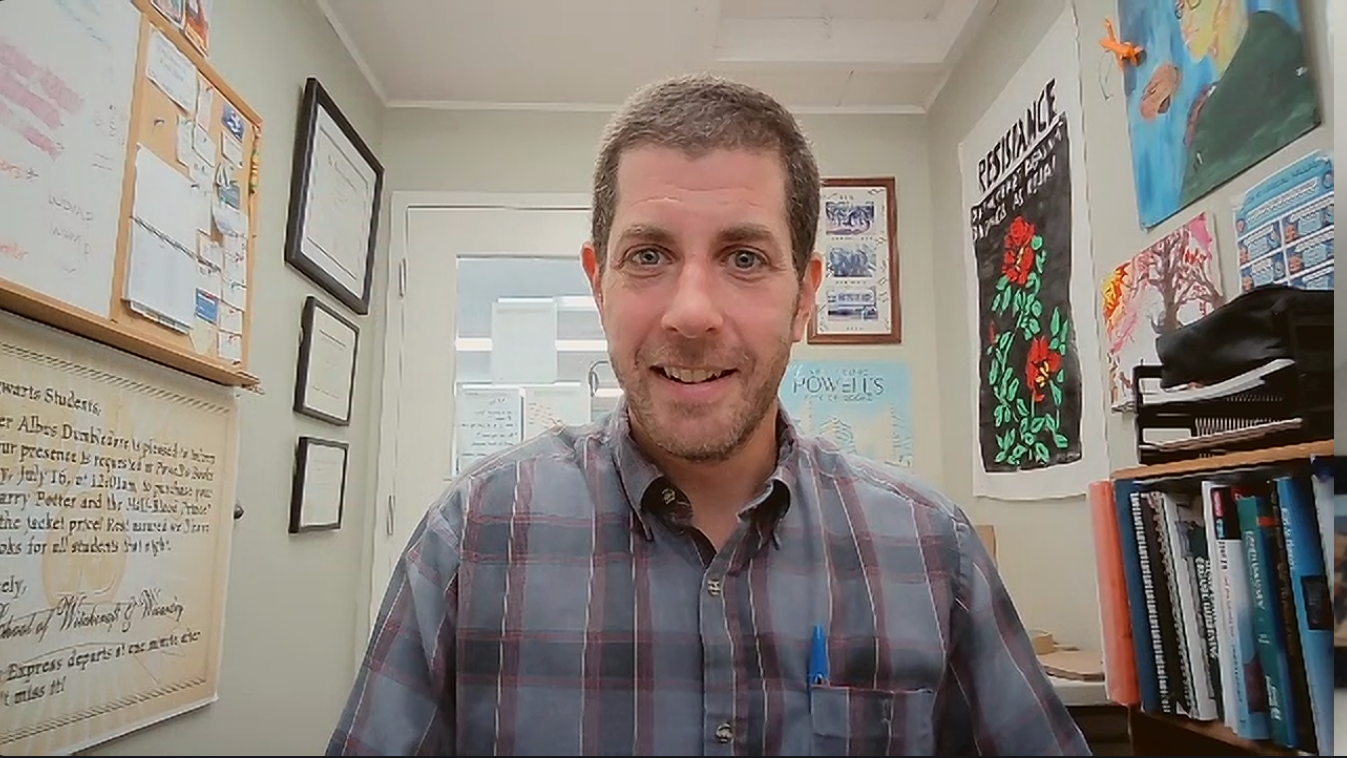
Paul in his office at Harwood Union High
Describe a few things you have learned through your fieldwork so far.
I have enjoyed the learning process I've had to go through in regard to just the nuts and bolts. For example, feeling comfortable eliciting stories and experiences from the people I interview. And what’s surprising is that the learning process has also helped me kind of reflect on myself. I'm learning about other people, but I'm also learning about areas where I myself want to grow in regard to self-confidence and interpersonal skills.
At this moment, what are your plans moving forward? Any ideas you can share about your community action project?
The interviews I've had have been awesome. They've been pretty expansive, but all the interviews that I've done so far are with individuals who are deeply ingrained, through their own choice, into the upper echelon of decision making around the communities in the Mad River Valley. Most interviewees have been select board members in some of the towns, and I’m gracious for their time and perspective. But what's become clear in the Valley is that there's kind of two worlds: one for those who have the time, resources, and knowhow to get involved in community building and one for those who might be less visible, but essential, to the community. They're the individuals that are running the markets, house cleaning, farming… So I think that's an area I am seeking to delve into: the individuals who are the lifeblood of the Valley, but may not be the decision makers.
With that being said, what I realized the community doesn't need is another forum to have a conversation about these things. I think the Mad River Valley has a history of having these collective forums, and what I have often heard in my interviews goes something like this: “You know, we're really good at talking about it, but what’s the next step?” So through some of the input of my interviewees I think I want to move away from that on some level.
One idea I have for my project is to make something that can go to select boards as part of an onboarding process to provide them with a wider perspective both on how things have changed, and what is currently happening. The other idea I'm thinking deeply about is a way to use my current work to highlight the original “Crucible of Change”— a collection of interviews in the Vermont Folklife Archive I’ve been referencing that was recorded in the Mad River Valley in the 1990s. Maybe I could create an exhibit located somewhere central to the community that might involve tying quotes from the current interviews I'm doing to quotes from that archival collection.
The last option I’m exploring involves our school, Harwood Union High School, where I teach. Our school has a rich history of hosting events called “Socrates Cafes.” Students facilitate them, we invite the community, and there's small circles of public discussion around a “timely and timeless” question. Having students grapple with my project’s focus questions, delve into both my recordings and archival recordings, and structure / host / facilitate the event could serve a different need than past community discussions. If you think about my question: “How does the past inform the future?” These students are the future. So that's an interesting link.
~ Paul Kramer
Katherine Leung - Milton, VT
How do Asian Jews in Vermont live? What are our lives like?
Briefly describe what your experience has been like in this program so far:
My experience in the program so far has been wonderful. I’ve been to two Vermont towns I wouldn’t have ventured into otherwise. You definitely get what you put into it so I also enjoy the self-driven aspect of the Fellowship. I am also learning a lot through the mentorship aspect of the Fellowship.
(At this point) what is the overarching question about your community that’s guiding your research?
The overarching question about my community is “How do Asian Jews in Vermont live? What are our lives like?” I intended to learn more about the holidays and traditions people celebrate in their homes, and what rituals were observed during marriages and births.
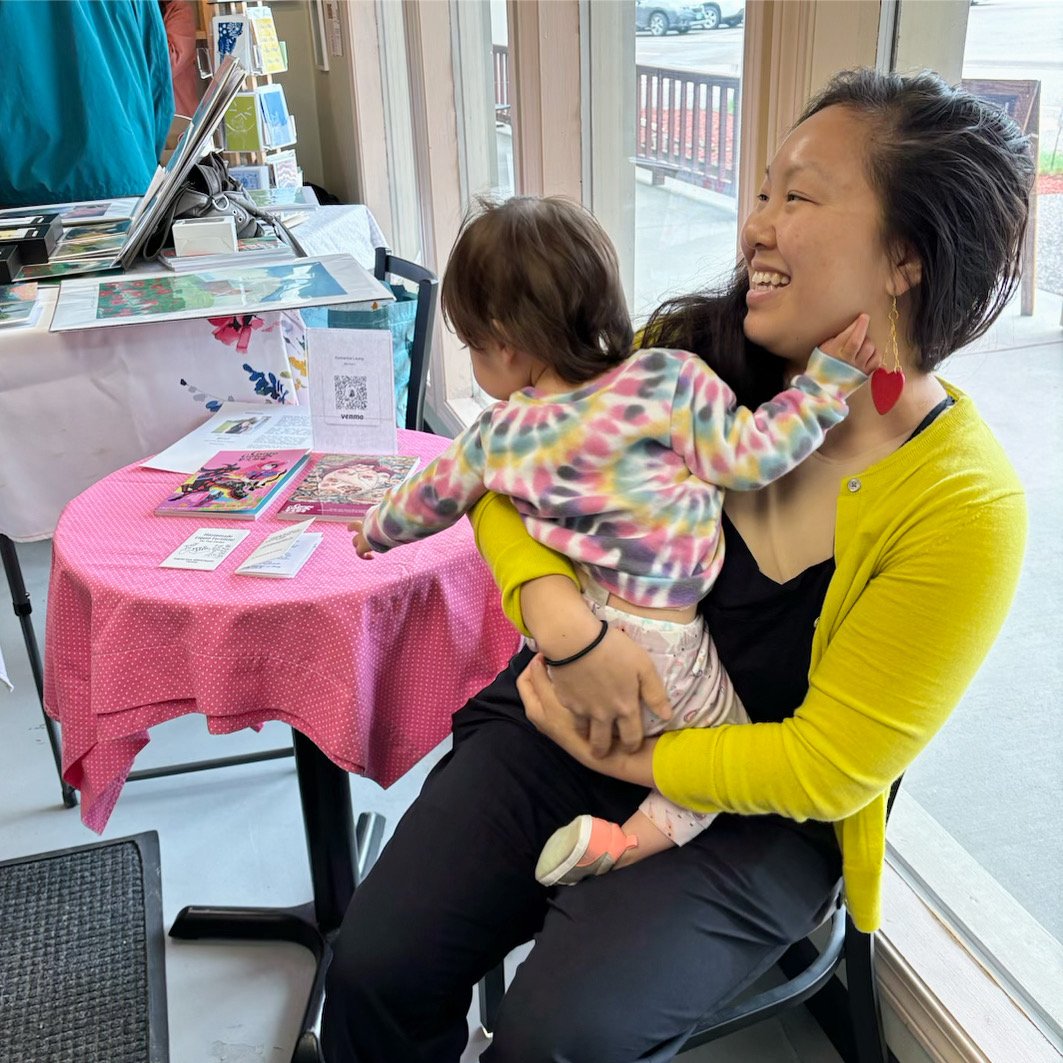
Katherine with her daughter
Describe a few things you have learned through your fieldwork so far:
Originally, I thought I would be talking mostly to moms like myself, because those were the touchpoints of Asian Jewish families I was encountering most in my life. I had met some moms through playgroups and storytimes around Chittenden County when I first began this fieldwork.
However, as I met more Asian Jewish families, the working definition began to shift. Mixed-race people, adoptees, parents who came from one culture and were partnered with the other - anyone who fit the “Asian Jewish” category loosely all participated in my fieldwork process. I got to invite a UVM student to my home to eat with my family. I got to participate in a meal train to support a newly postpartum mom and her Asian Jewish baby. I got to talk to a really cool nine year old from Waterbury.
What has been equally incredible is the people that I have met after collecting all the interviews. This fellowship has emphasized the importance of collecting community feedback. Because of my lack of time and capacity to meet in person outside of the interview collection process, I created a zine with some interview snippets, as well as a QR code to a playlist where people can listen to some interview segments on their own. I mailed this to every participant. I gave people opportunities to respond with a worksheet that was already stamped and addressed back to me - and virtually, if they chose.
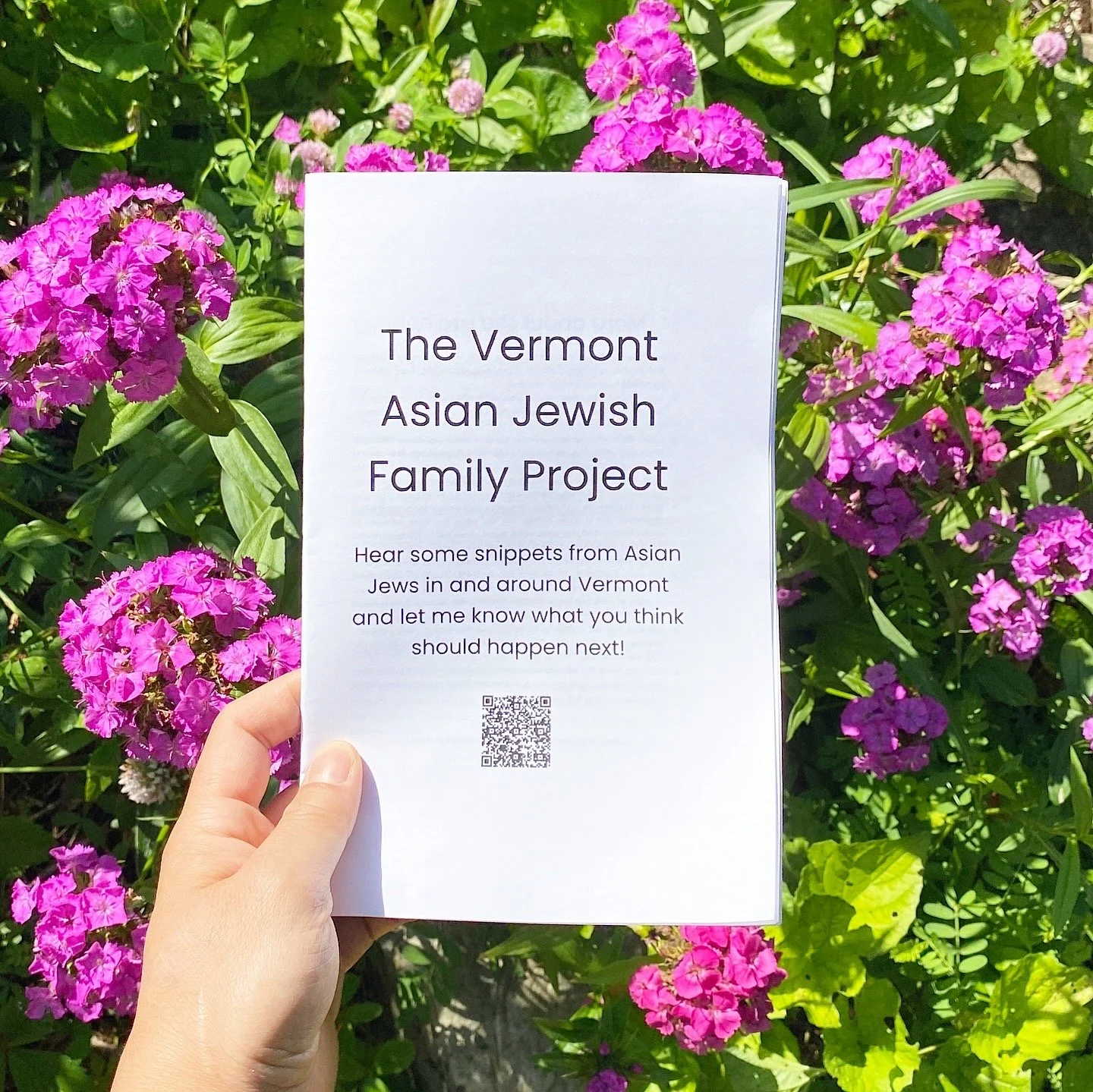
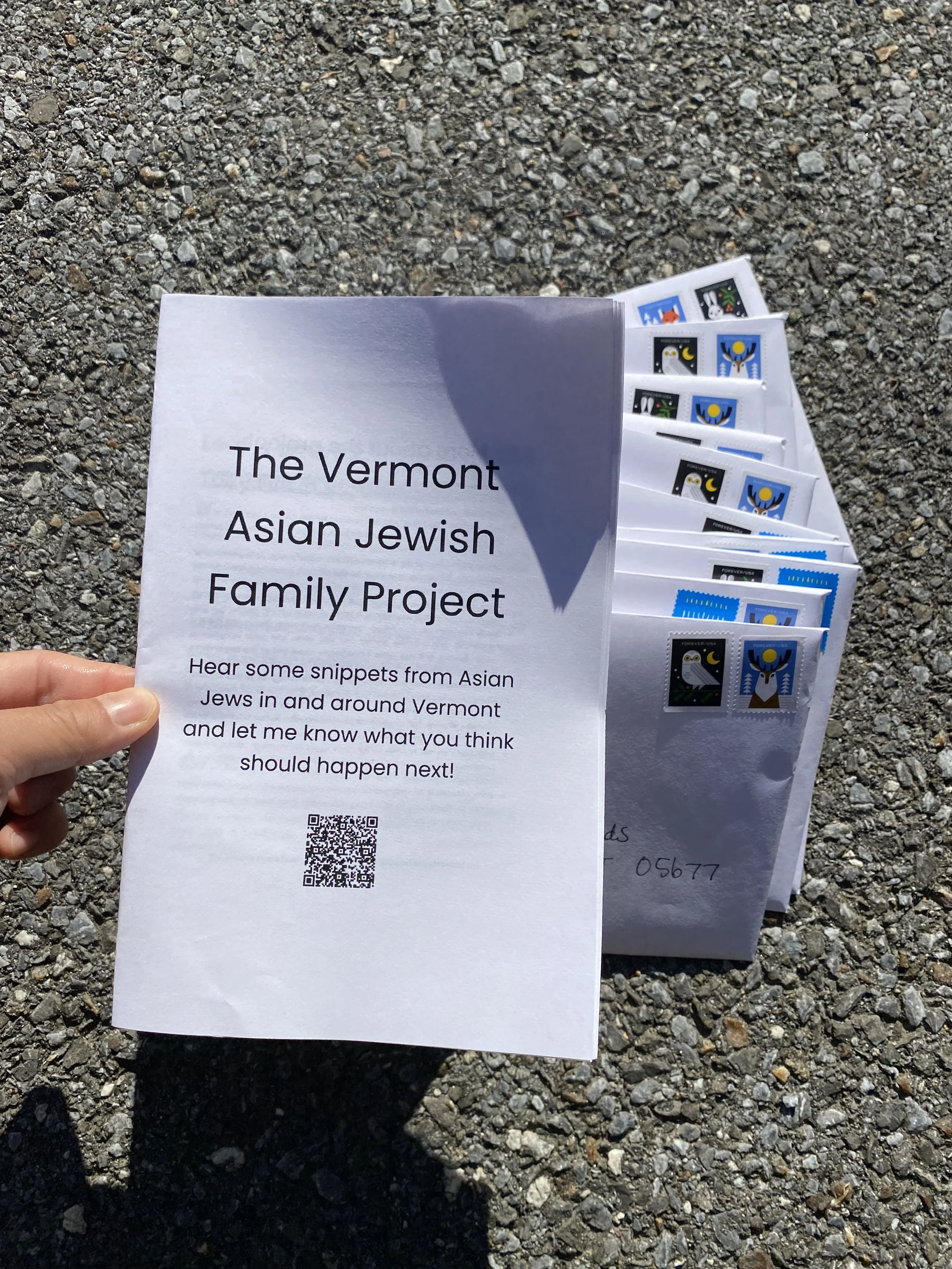
I had advertised the “free community feedback zines” in a Facebook group for Asians living in Vermont, and on my Instagram page. As a result, a lot of people in and around Vermont, as well as outside of Vermont found out about this project that way.
I found out that my project was being circulated in a group chat for Queer East Asians in Western Massachusetts! Many of those participants reached out for a zine. I also learned that a leader of a Burlington-based synagogue had circulated my zine to their network. An Asian Jewish adoptee reached out to me and we got to meet up for creemees today!
I set out on this fellowship to learn more about “my community”, but it morphed into a way for me to gain parenting skills on how to raise a mixed-race Asian Jewish kid in Vermont (being only one race myself), but actually, I’m creating a village whom I will be celebrating holidays with for the years to come. I feel so great about that.
At this moment, what are your plans moving forward? Anything ideas you can share about your community action project?
I am working with an audio producer to turn the stories I have collected into a podcast. Many participants had shared interest in hearing the stories of “people like them”. Our geographic isolation makes it difficult to meet up. Our racial and religious backgrounds also make it difficult to attend temple. I hope upon completion of the podcast we can have a listening party to support more Asian Jews meeting in person.
I am currently seeking funding to support a local queer BIPOC audio producer to provide fair compensation for the hours and expertise they will provide the podcast.
~ Katherine Leung