
Baseball Folklife - A Conversation with Troy Boyer
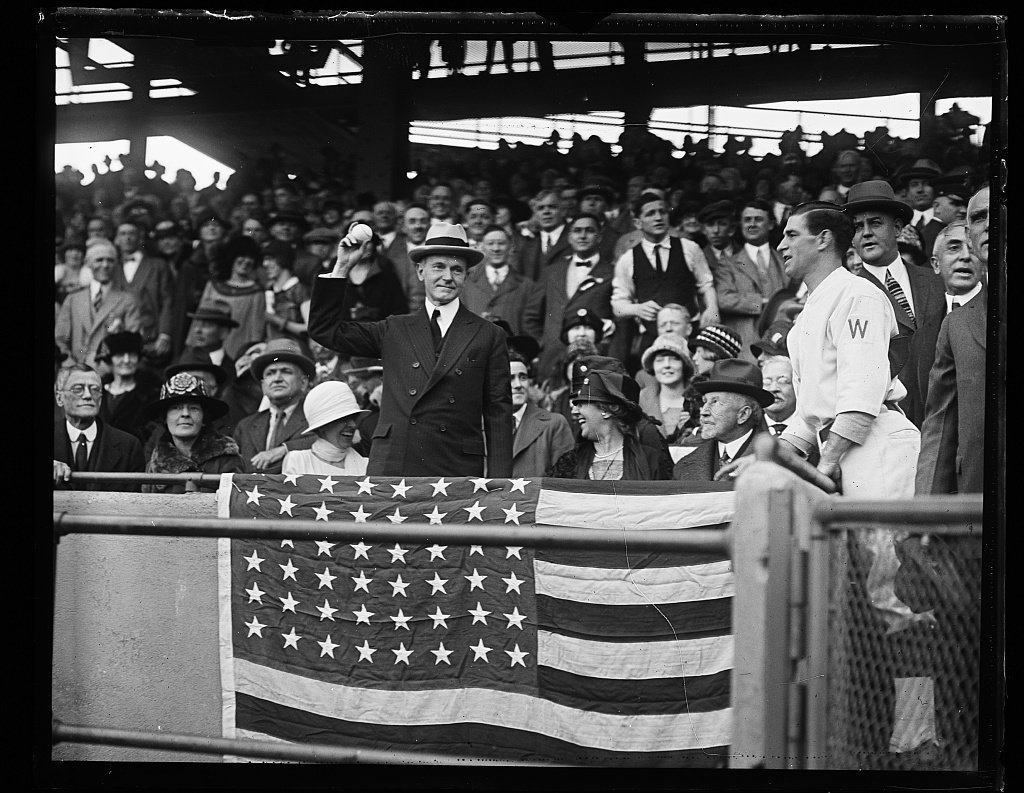
Source: Library of Congress Prints and Photographs Division, Harris & Ewing photograph collection, [Calvin Coolidge throwing out baseball at game].
On July 28, 2026 the Vermont Lake Monsters are sponsoring a fundraising game for Vermont Folklife! It’s a great opportunity to see our hometown team take on the Westfield Starfires and raise funds to support our work! Discounted tickets are $9.50, and $4.00 of each ticket goes directly to Vermont Folklife.
Ahead of the big game, Vermont Folklife staff folklorist Andy Kolovos set out to learn more about the folklore and culture of baseball—in other words, to explore BASEBALL FOLKLIFE! And he immediately knew who to call: his old friend, folklife scholar and lifelong baseball enthusiast (including forty-five years of playing hardball), Troy Boyer.
Troy and Andy met in graduate school at the Indiana University Folklore Institute 30 years ago, and Troy very graciously offered his time to discuss (via telephone, seeing as he lives in Pennsylvania) baseball folklore with Andy on a recent Friday evening. Andy and Troy spoke for over an hour, and what follows are some highlights from their conversation.
Baseball and Folklore
Since the word folklore can be hard to pin down (for example, Funk & Wagnalls Standard Dictionary of Folklore, Mythology, and Legend, published in 1949, contains 21 definitions, and the American Folklore Society offers 11 more on their What is Folklore? site), the pair’s first goal came in defining just what they meant by baseball folklore.
Andy: So, I don't really know where to begin with this except to say, when the words “baseball” and “folklore” come together, what do you think of?
Troy: I think of the informal side of the game—even when it’s part of organized baseball.
So what does Troy see as examples of the informal culture of baseball? What are some of the things that players and fans do that, while not part of the official rule book, are central to the experience of participating in the sport—both on the field and off?
Troy: I mean, there’s all kinds. One of the things I could think of as a semi-formal tradition is the seventh-inning stretch.
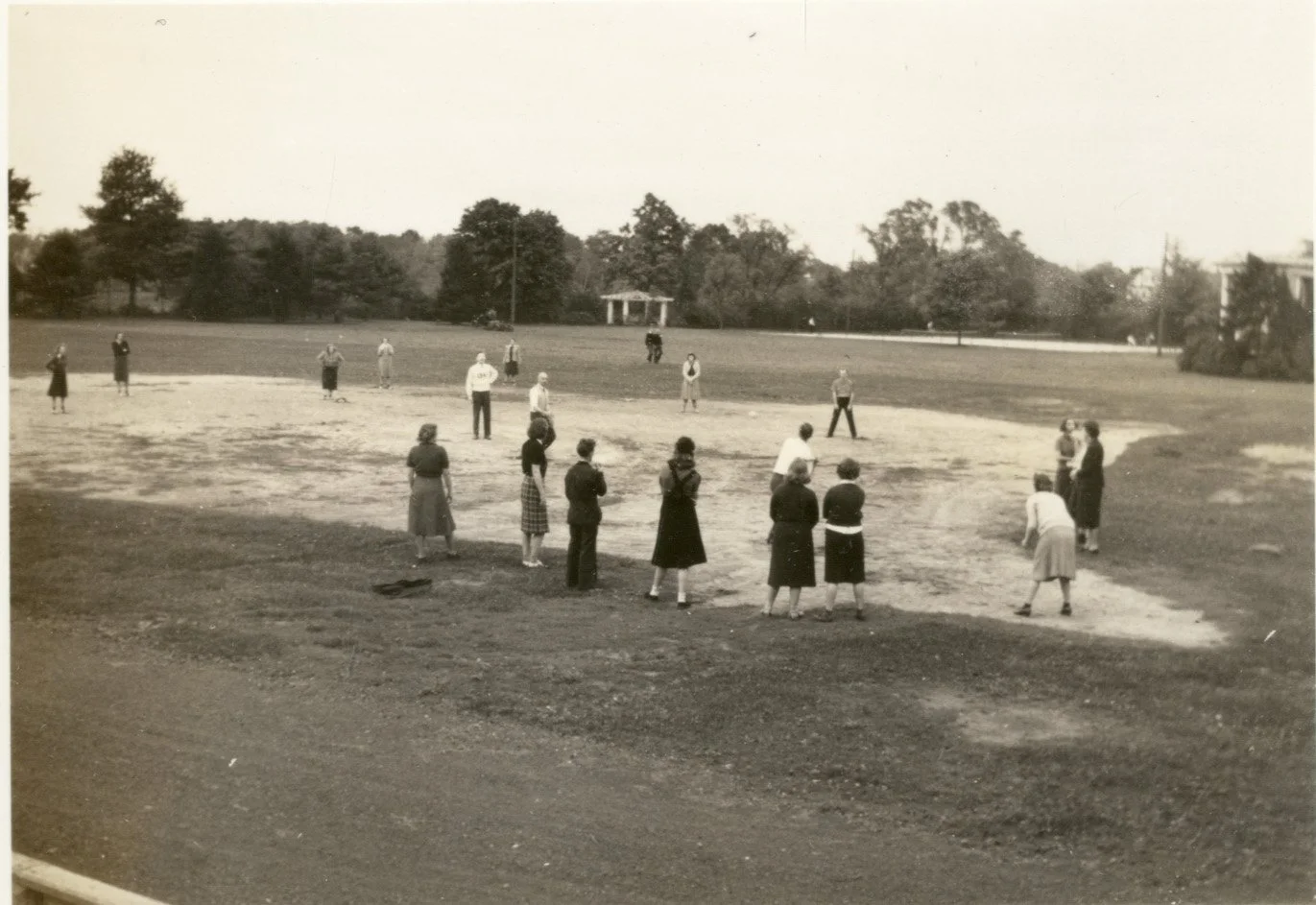
Source: Vermont Historical Society, Shrewsbury Photos of Olof C. Johnson, Playing baseball (1939).
Seventh-Inning Stretch
The seventh-inning stretch is a long-standing tradition at baseball games—a break in play in the middle of the seventh-inning that involves, well, standing up and stretching, and also sing-alongs of songs like Take Me Out to the Ballgame, music, as well as things like buying snacks and beer. And, from a practical perspective, it gives the players a short break as well.
The seventh-inning stretch is not part of the rules of baseball: it’s an informal tradition that has become standard—and expected—at professional and semi-professional games. And depending on who you talk to, it’s been part of baseball for over 150 years. And while the origin of the seventh-inning stretch is debated, from Vermont Folklife’s perspective, how traditional activities began is less significant than what they mean to the people who practice them in the present.
What’s another of Troy’s examples?
Troy: It’s called the wisdom of the game, and it’s not written down, but gets taught to you somewhere. One that comes up so often is what are called unwritten rules of baseball. So almost by definition, it’s taught by oral tradition, right? It’s not written down. And most of these are kind of negative, like stuff you should never do—and if you do it, you’re a naughty baseball player.
The Wisdom of the Game
Rules that address things you should not do are a pretty central part of folklore in general, from folk beliefs about bad luck and magic, all the way to things like folk and fairy tales. Folklorists even have a word for them: injunctions. An injunction is a prohibition or taboo against taking some kind of unapproved action to prevent avoidable consequences. A classic example of an injunction in a fairy tale is the warning given to Red Riding Hood when she departs for her grandmother’s house: “Behave yourself on the way, and do not leave the path...”
And we all know how that turned out…
Baseball has plenty of its own injunctions, and here is a selection of these unwritten rules of baseball that Troy shared:
Never step on the foul lines when you’re going out to, or coming in from, the field.
Don’t cross the handles of bats set out near the dugout.
Don’t wash or change clothes/alter your diet/shave/bathe/etc. when you’re on a streak.
Don’t talk about a no-hitter when it’s in progress, or the pitcher will give up a hit.
Never swing at a 3-0 pitch unless it's right down the middle.
Troy assured Andy that, as far as these unwritten rules of baseball go, he’s “never broken” any of them–or at least the unwritten rules he personally knows. And although he knows a lot of them, there might be some he doesn’t…and what happens if you break a rule you never knew existed?
These are just a few examples of one kind of baseball folk belief (those grounded in what we’re calling injunctions)–there are many, many more out there, and as a part of the long-standing oral tradition of baseball, they are components of the larger culture of the game.
But what do we mean by a culture of baseball?
A Culture of Baseball
In ethnographic fields such as folklore studies, anthropology and sociology, the concept of culture holds a central place. However, like defining folklore, defining culture continues to be a somewhat fraught exercise. Thankfully, the American Anthropological Association produced a great, concise (60 seconds!) overview of the concept of culture as a part of their Anthro Minute series on YouTube: Anthro Minute Episode 3: Culture. The presenter, Dr. Melissa Vogel, breaks culture down into a super brief definition: “Learned and shared beliefs and behaviors.”
While this is pretty broad (there is a lot more to consider, and Dr. Vogel goes into those details in the video and its follow up, Anthro Minute Episode 4: How Culture Shapes Everything You Do), it does get at the fundamentals. Furthermore, it’s open enough to apply to the culture of large groups of people (let’s say, Japan) and smaller groups—like baseball players and fans.
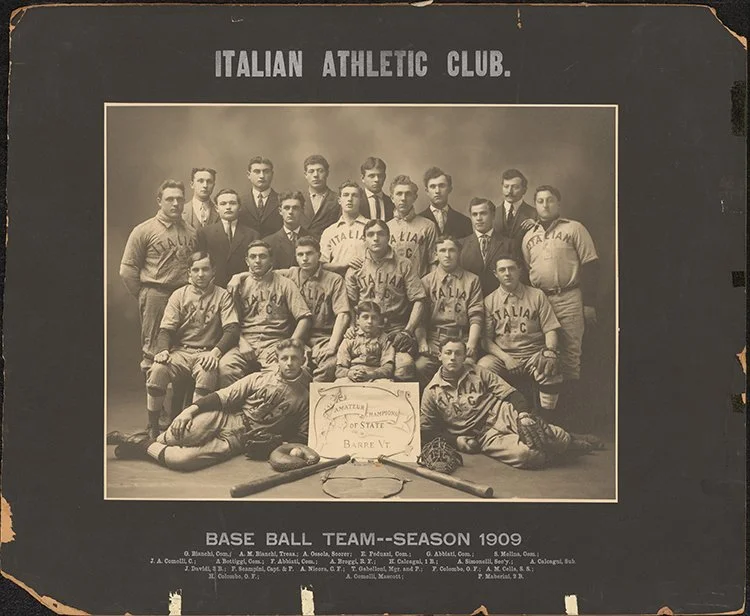
Source: Vermont Historical Society, Barre Italian Life Collection, Italian Athletic Club 1909 Baseball Team.
To understand the culture of contemporary baseball, Troy looks back to its foundations:
Troy: Baseball begins as a children’s game, but when it is first organized as an adult sport—it's a gentlemanly game.
And as a “gentlemanly” game, ideas like fair play and sportsmanship, as well as honor and respect, were–and remain–foundational to how players engage with each other and with game officials.
To a degree at least.
Still, Troy notes that there are many unwritten rules in baseball that focus on mutual respect, for example, ways in which players on a team that’s way ahead in the score treat their competitors.
Troy: You should never show up the other team…you know, don't steal bases when you're already ahead by a lot of runs, because you're just rubbing it in on the other team.
And returning to something we mentioned earlier, the 3-0 pitch:
Troy: You should never swing at a 3-0 count pitch when you're ahead by a lot in the game, because you're rubbing it into the other team.
And the same goes for officials.

Still from the 1946 Looney Tunes cartoon, Baseball Bugs. Image © Warner Bros. Discovery.
Troy: Don't show up the umpire. Like, you can argue with him, but once you do something that the fans can hear or where people can tell you are now making a real ass out of him, then you're going to get thrown out of the game.
What are the consequences for violating these unwritten rules? Well, let’s just say that “respect” and “honor” are two-sided things. Culture is dynamic, not fixed. It changes over time. And Troy suggests that—over time—these ideas of respect and honor in baseball shifted from an older-style gentlemanly conception into more of what he calls “Street-level respect.”
Troy: That also then translates into “street smarts” later on, or “street respect”—street-level respect. I mean, some of the most vicious fights that have occurred in major league baseball have been from guys that you would think probably have less interest or respect in the gentlemanly traditions of the game:“Hey, you're showing me up. You’re making an ass out of me. I'm going to kick your ass.”
And yet that itself has become tradition.
Through it all, though, the culture of the game continues to be grounded in sportsmanship, respect and fair play.
Troy: There's, there's still a kind of, you know, sporting respect, whether it's gentlemanly or street smarts. There's still that kind of element in baseball that I don't think you see as much in, say, football—or definitely not in basketball, where a guy dumps on you and flexes. You would not see that in baseball.
We are so grateful to Troy for taking the time to share his perspectives on America’s great pastime.
Robert Troy Boyer is an Adjunct Instructor of History and American Studies at Lebanon Valley College, where he and two colleagues developed a four-course sequence on baseball for the College's General Education Program. Troy developed and teaches the social science portion of the sequence and has taught the baseball humanities course as well. Along with baseball, over his career, Troy has taught courses on folklore and folklife, literature, history, philosophy, and Pennsylvania German studies and has published a number of essays in a variety of outlets, including The Oxford Handbook of American Folklore and Folklife Studies.