Archival Connections for Multilingual Educators and Learners
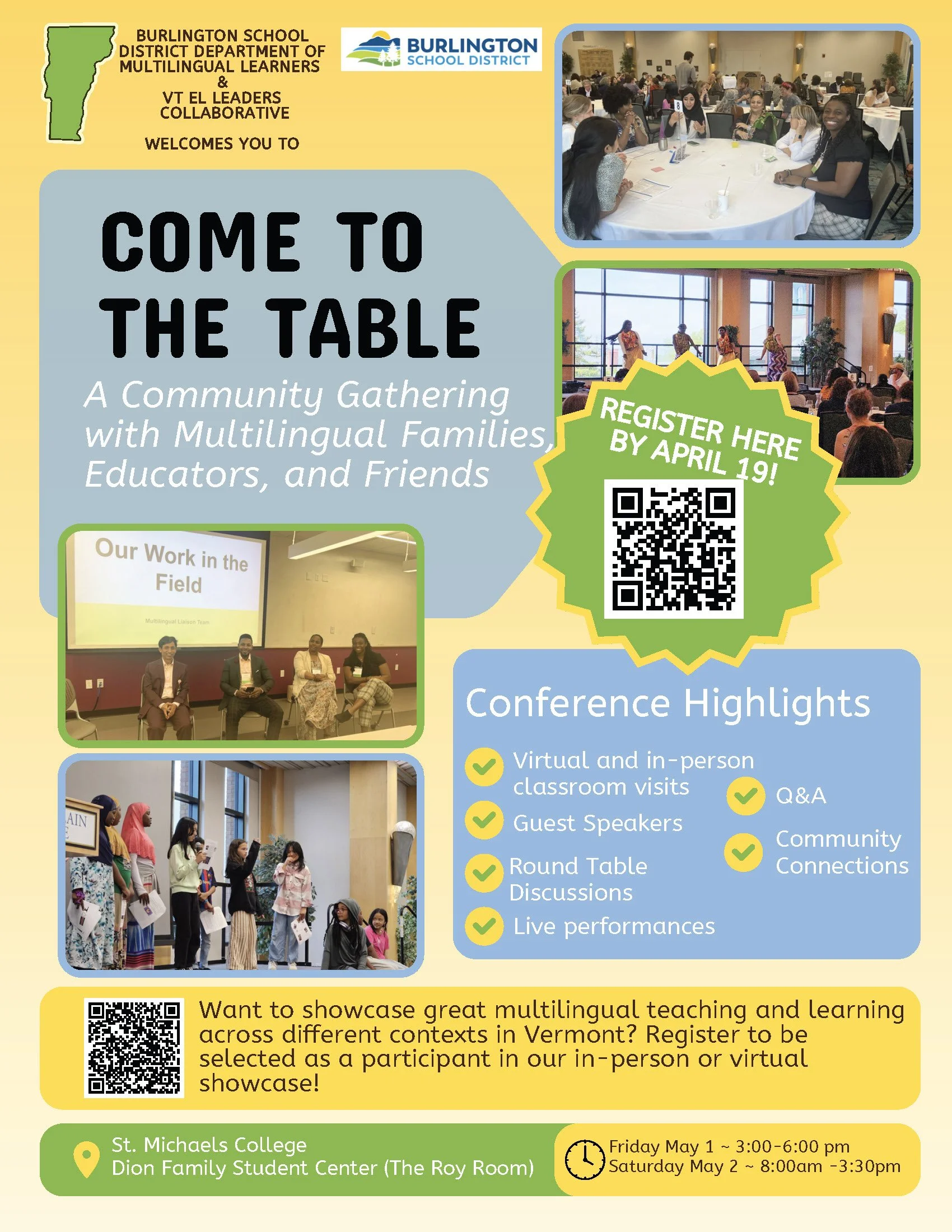
Kate and Mary (Exec. Director and Dir. of Education at Vermont Folklife) were honored to take part in a professional development event hosted by the Vermont EL (English Learners) Leaders Collaborative and the Department of Multilingual Learners of the Burlington School District. “Come to the Table,” brought together Multilingual Learner Specialists (MLLs) specialists and educators from across the state to share resources, build relationships, and strengthen support for immigrant and refugee students and families.
The event offered a meaningful opportunity to connect Vermont Folklife’s archival collections with the work educators are doing in classrooms today. For decades, Vermont Folklife has collaborated with communities across the state to document the oral histories and lived experiences of Vermont’s diverse cultural communities. Many interviews and recordings in our collections offer valuable perspectives on what it means to build a life in Vermont while navigating multiple languages, adapting to a new culture, and sustaining traditions that foster a sense of home and belonging.
Here are some examples of materials we shared at the conference and from our broader collections on these themes:
Mohamed Abdi
Mohamed Abdi was interviewed in 2014. At the time he was speaking as the founder of the newly formed Somali Bantu Community Association of Vermont. Reflecting on his experiences as a community leader and a father, Mohamed speaks about the distinction between assimilation and integration for individuals and families who have resettled in Vermont.
-
Mohamed Abdi - Integrate vs. Assimilate
Mohamed Abdi: So that is what we want to teach young kids—to understand the value of their culture, and also not just for their culture. We want them also to integrate into American culture so they can be successful. So that is not total assimilation—but to integrate—that's what we focus on.
My own vision as a father and also a community leader is…what I want to see is a community that can work side by side with the American community, but not to assimilate into that culture. I don't want to see people forgetting or not speaking their own language, and I don't want to see people leaving their own culture into another culture. Because that piece is very important in me.
That's my vision: to keep everything neutral. Not on this side 100%, and not on this side 100%, but in the center. Where you can have your Somali Bantu face when you come to the community elders or in the community, but when you go out, we also want zaS someone to be successful. In order for him to be successful, he must also learn from the other culture. So that is what my vision is.

Martha Pellerin
Martha Pellerin
Martha Pellerin was a musician, educator, scholar, and tireless advocate for Franco-American culture in Vermont. She grew up in Barre after her family immigrated from Québec, and she spoke movingly about the conflicting messages she received as a child at school where she was encouraged to leave French behind in order to adapt in an English-speaking state.
Martha’s work as a community documentarian is preserved in the Vermont Folklife Archive in the Martha Pellerin Collection of Franco-American Song.
-
Martha Pellerin - “Franco-American”
Greg Sharrow: What about your identity as a Franco American? I realize there's lots you could say.
Martha Pellerin: Where to begin. Well I guess kind of a summary of it all…in graded school most first generation Franco Americans are told to not speak French, to learn English. And their French language skills usually weren't valued. So you learned pretty quickly. I don't think it was an intentional thing. I think that the teachers—I don't mean to down, bad mouth the teachers we had. I think that they were trying really hard to give us the best opportunity to succeed in this culture that we had just moved into. So they weren't being mean, they were just trying to help us. But in the process they didn't realize that they were giving us a message that said your culture isn't valued. And we learned that lesson too well, unfortunately.
But to be a first generation Franco American basically you deal with most of your life—lots of cultural conflicts that by the time you're…before you're 20, when you're in high school even, 16, 15 years old you're pretty burned out…because you're continuously given mixed messages. In graded school you're told not to speak French. You get to high school and you have to take a second language, and suddenly it's important to know French, and you've almost lost all your French already because you've tried so hard to do right, to do the right thing. Then you get into high school and they're like, “You should take French!” And then you get into French class and you figure you're going to get an easy A and you come out with a D because they don't like the way you speak French. And also because you're good orally, but you know nothing about reading or writing it. And the teacher assumes that you know all of it, right?
It never occurs to them that through your whole 8 years before they see you from kindergarten to 8th grade that you've never given the opportunity to expand on your French language skills, that's all been squashed. And then when you get to high school they make you feel like sh** because you don't have all those skills. So no matter what it's always a situation where you always feel inadequate. You never quite feel like you got it all together. And I'm sure that's the same with lots of first generation ethnic anybody. I'm sure it's not just an experience that Francos had.
Martha and Mohamed’s reflections on language loss, cultural continuity, and the challenges of living between worlds continue to resonate with people and communities who are making Vermont home today.
Sharing these examples at “Come to the Table” led to rich conversations, which underscored the important role that folklife and community archives can play in supporting educators and social service organizations. Historical and contemporary voices from Vermont Folklife’s collections offer opportunities for students to see their own experiences reflected and for educators to better understand the complex journeys of multilingual learners and their families.
Thanks to the event organizers for inviting us “to the table!”
Thanks to funding from the Canaday Family Charitable Trust, Vermont Folklife is working towards the development of an educational resource called “Making Vermont Home,” designed to support Vermont educators interested in presenting the experiences of contemporary, 21st century immigrants and refugees in middle and high school classrooms.